
Understanding Racism and Mental Health
Understanding Racism and Mental Health Racism is a deeply ingrained social issue that has significant impacts on mental health. The relationship between racism and mental
We are open on Saturdays now! | We are doing Virtual Appointments. | Most HMO Plans Accepted.


Obsessive-Compulsive Disorder rarely stays the same from year to year. For some people, symptoms fade into the background for long stretches and then resurface during stressful seasons of life. For others, the intrusive thoughts and compulsions seem to grow louder with every passing decade.
If you or someone you love has been living with OCD for years, you have probably asked yourself: does OCD get worse with age, or is there something else going on? The short answer is that OCD does not automatically worsen simply because a person gets older.
But aging brings new stressors, hormonal shifts, health changes, and life transitions, and any of these can cause OCD symptoms to intensify if the disorder isn’t actively managed. In this guide, we’ll walk through how OCD evolves over a lifetime, what tends to make it worse, the warning signs to watch for, and how treatment at Faith Behavioral Health can help you or your family member regain control at any age.
Age itself is not a direct cause of worsening OCD. Research on the course of OCD shows that the disorder tends to be chronic and fluctuating rather than steadily progressive, meaning symptoms often wax and wane rather than climb in a straight line. However, several age-related factors can make OCD feel more intense over time:
In other words, it isn’t age that worsens OCD; it’s what tends to accumulate with age. This is why proactive, ongoing care matters so much, regardless of whether someone was diagnosed as a child or later in life.
OCD can look strikingly different at age 10, age 30, and age 60. The core pattern intrusive thoughts followed by compulsive behaviors meant to ease the anxiety stays the same, but the specific themes, intensity, and triggers often shift with each stage of life.
Life Stage | How OCD Often Shows Up |
Childhood | Contamination fears, checking behaviors, need for symmetry, reassurance-seeking from parents |
Adolescence | Intrusive thoughts about identity, harm, or morality; social and academic performance-related rituals |
Young Adulthood | Relationship-focused OCD, career and decision-making doubts, health anxiety |
Midlife | Symptoms tied to parenting, caregiving stress, career pressure, or postpartum/hormonal changes |
Older Adulthood | Health-related obsessions, checking behaviors linked to memory concerns, symptoms that resurface after decades of remission |
It’s also common for OCD to go into partial remission for years, sometimes even decades, only to resurface during a major life transition. A move, a new diagnosis, a loss, or a change in routine can reactivate symptoms that once felt fully managed. This doesn’t mean treatment failed; it usually means the underlying vulnerability to OCD is still present and needs renewed support.
Several overlapping factors can push OCD symptoms from manageable to overwhelming. Recognizing these triggers early can help you or your provider adjust treatment before a full relapse occurs.
It’s worth noting that engaging in compulsions even briefly reinforces the OCD cycle. The temporary relief a ritual provides teaches the brain that the compulsion “worked,” which strengthens the urge to repeat it next time. Over months and years, this reinforcement can make symptoms feel far more severe than when they first started.
It’s also worth remembering that a worsening symptom picture doesn’t always mean something has gone wrong. Sometimes it simply means life has changed faster than a person’s coping tools have kept up. Recognizing the specific trigger behind a flare-up is often the first step toward getting symptoms back under control.
OCD symptoms don’t always announce themselves clearly. Many people minimize or hide their rituals out of shame, which can allow the disorder to progress quietly. Watch for these warning signs in yourself or a loved one:
Category | Early Signs | Signs of Escalation |
Time spent on rituals | A few minutes here and there | More than one hour per day (a common clinical threshold) |
Avoidance | Avoiding a specific trigger occasionally | Avoiding entire places, people, or routines |
Reassurance-seeking | Occasionally asking a family member for reassurance | Repeated, urgent reassurance requests that disrupt relationships |
Daily functioning | Rituals fit around work, school, or sleep | Missed work, school refusal, disrupted sleep, or late arrivals |
Emotional state | Frustration or embarrassment about symptoms | Persistent anxiety, hopelessness, or depressive symptoms |
If OCD is taking up more time, narrowing someone’s world, or beginning to affect relationships and responsibilities, it’s a strong signal that current coping strategies are no longer enough and that it’s time to reach out for professional support.
Yes. OCD is highly treatable at any age, and most people see meaningful, lasting improvement with the right combination of therapy and, when appropriate, medication. The most well-researched and effective treatments include:
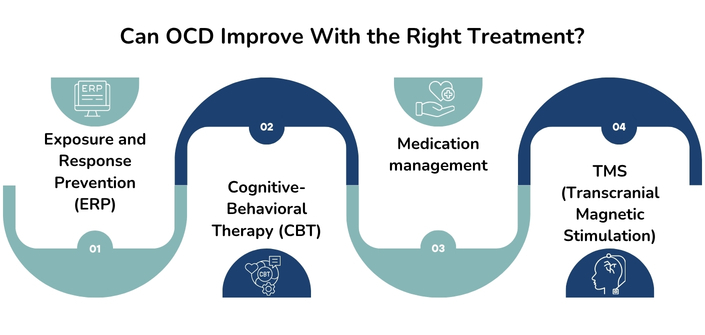
Long-term OCD management is less about eliminating every intrusive thought and more about building sustainable habits that keep symptoms from taking over. These strategies can help at any stage of adulthood:
Aging with OCD doesn’t have to mean losing ground. With the right support system and a proactive relationship with your care team, it’s entirely possible to keep symptoms manageable through every decade of life.
If you notice that rituals or intrusive thoughts are taking up more time than they used to, or if you’ve begun avoiding certain places, people, or responsibilities because of OCD, it may be time to seek a professional evaluation. Reaching out for support is also important if symptoms that were once well managed have started to return, or if OCD is interfering with your sleep, work, school, or relationships.
Additionally, experiencing new obsessions or compulsions for the first time later in life is a good reason to consult a mental health professional. Learn more about our approach to obsessive-compulsive disorder treatment or explore our OCD treatment services, or contact Faith Behavioral Health today to schedule a consultation at one of our convenient Texas locations.
OCD doesn’t get worse simply because of the number of candles on a birthday cake, but life’s changes, stressors, and hormonal shifts can absolutely make symptoms feel heavier over time if they go unaddressed. The encouraging news is that OCD remains treatable at every age. With the right combination of therapy, medication, and ongoing support, most people can keep their symptoms manageable and continue living full, meaningful lives well into every stage of adulthood.
Understanding Racism and Mental Health Racism is a deeply ingrained social issue that has significant impacts on mental health. The relationship between racism and mental

Relationship between ADHD & Dementia: Understanding the Link A Closer Look at the Relationship between ADHD & Dementia ADHD and dementia are two neurological conditions

Overcoming Self-Abandonment with Self-Preservation Self Abandonment is a concept that many are familiar with but rarely discuss. It is the act of neglecting one’s own

As a skilled psychiatrist, I specialize in preventing, diagnosing, and treating mental health issues, emotional disorders, and psychotic conditions. Drawing on diagnostic laboratory tests, prescribed medications, and psychotherapeutic interventions, I strive to provide comprehensive and compassionate care for my patients in Frisco and McKinney, Texas, while assessing their biological, psychological, and social components of illnesses. I am committed to helping them achieve healthier and more fulfilling lives through my work.