
Brief Psychotic Disorder: What It Is, Why It Happens, and How to Get Help Fast
Brief Psychotic Disorder: What It Is, Why It Happens, and How to Get Help Fast Imagine waking up one day and suddenly losing touch with
We are open on Saturdays now! | We are doing Virtual Appointments. | Most HMO Plans Accepted.

Post-traumatic stress disorder (PTSD) is often associated with flashbacks, nightmares, and heightened anxiety. But one of its lesser-discussed effects is its impact on memory. Many people living with PTSD notice they forget appointments, lose track of conversations, or struggle to recall details of their daily lives, and yes, PTSD can absolutely contribute to memory loss. This connection is rooted in how trauma changes the brain’s structure and chemistry, and understanding it is the first step toward finding relief.
For someone navigating this on top of everything else PTSD brings, memory lapses can feel confusing, frustrating, and even frightening. You might wonder if something is seriously wrong with your brain, or worry that you’re losing your grip on reality. In most cases, neither is true. What you’re experiencing is a well-documented neurological response to trauma one that mental health professionals see regularly and know how to treat.
Trauma doesn’t just live in a person’s thoughts and emotions; it physically reshapes the brain. When someone experiences a traumatic event, the brain’s stress-response system floods the body with cortisol and adrenaline. In small doses, this response is protective. But when trauma is severe, repeated, or unresolved, chronic exposure to these stress hormones can interfere with the brain regions responsible for forming and retrieving memories.
Three brain structures play a central role in this process:
Together, these changes explain why PTSD memory problems often look less like “forgetting everything” and more like difficulty concentrating, disorganized recall, and gaps around the traumatic event itself.
Trauma affects memory through several interconnected pathways. Understanding the “why” behind these problems can help people feel less alarmed and more empowered to seek support. Rather than a single cause, memory problems in PTSD usually result from the combined effect of biological, psychological, and behavioral changes that occur after a traumatic experience.
Contributing Factor | Effect on Memory |
Elevated cortisol levels | Impairs the hippocampus, reducing its ability to store and retrieve memories accurately. |
Hyperarousal (fight-or-flight) | Keeps the brain focused on perceived threats rather than encoding routine information. |
Dissociation | Creates gaps in memory as the mind mentally distances itself from distressing experiences. |
Sleep disruption | Interferes with memory consolidation, which largely occurs during deep sleep. |
Chronic anxiety and intrusive thoughts | Divides attention, making it harder to focus on and retain new information. |
Avoidance behaviors | Can suppress conscious recall of trauma-related details, leading to fragmented memories. |
It’s important to understand that these memory issues are not a sign of weakness or a permanent flaw; they are a natural, biological response to overwhelming stress. The brain is doing its best to protect itself, even when that protection creates side effects like forgetfulness or confusion. Recognizing this can relieve a significant amount of self-blame that many trauma survivors carry, especially those who feel embarrassed about forgetting names, appointments, or conversations that feel like they “should” be easy to remember.
Memory difficulties associated with PTSD can show up in several distinct ways, and they don’t always look like classic “forgetfulness.” Recognizing these patterns can help individuals and their loved ones understand what they’re experiencing, put a name to it, and feel less isolated in the process.
Type of Memory Problem | What It Looks Like |
Short-term memory lapses | Forgetting recent conversations, misplacing items, or losing track of tasks. |
Fragmented trauma memories | Recalling the traumatic event in disjointed pieces rather than a clear sequence. |
Difficulty forming new memories | Struggling to retain new information, such as instructions or names. |
Intrusive memories | Involuntary, vivid flashbacks that intrude on daily thoughts. |
Dissociative amnesia | Significant gaps in memory surrounding part or all of the traumatic experience. |
Working memory issues | Trouble holding and manipulating information, such as following multi-step directions. |
These experiences vary widely from person to person. Some individuals mainly struggle with everyday forgetfulness, while others primarily experience fragmented or intrusive memories of the trauma itself. It’s also common for someone to experience several of these patterns at once
Yes, for many people, memory problems linked to PTSD can improve significantly, especially with the right treatment and support. The brain has a remarkable capacity for change, known as neuroplasticity, which means that damaged or disrupted pathways can rebuild and strengthen over time.
This is one of the most hopeful truths about trauma recovery: the same brain that adapted to protect you during a threatening experience can also adapt toward healing once it feels safe again.
Several factors influence how much and how quickly memory improves:
While some memory changes may be long-lasting, most people see noticeable improvement in day-to-day memory and concentration as their PTSD symptoms are treated and stabilized. Progress is rarely linear; there may be good weeks followed by harder ones, but with consistent care, the overall trajectory for most people trends toward improvement rather than decline.
Because memory problems in PTSD stem from the underlying trauma response, treatment typically focuses on healing PTSD itself rather than memory in isolation. As the nervous system calms and traumatic memories are processed in a healthier way, cognitive symptoms like forgetfulness and poor concentration often improve as a natural side effect. Common, evidence-based approaches include:
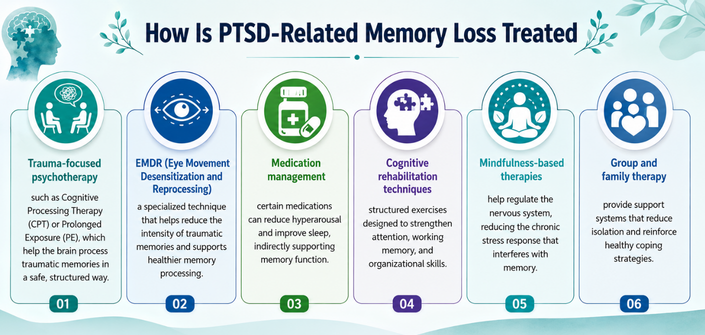
A comprehensive treatment plan, tailored to the individual, offers the best chance for both emotional healing and cognitive recovery. A qualified behavioral health provider can help determine which combination of these approaches is the right fit, based on the type of trauma experienced, current symptoms, and personal history.
Alongside professional treatment, there are practical, everyday strategies that can help manage memory challenges. None of these replace therapy, but they can meaningfully reduce daily frustration and give you a sense of control while your brain and body continue to heal:
Small, consistent habits like these can make daily life feel more manageable while the deeper healing work of therapy takes place. Over time, many people find that as their PTSD symptoms lessen, these coping tools become less of a necessity and more of a helpful backup.
PTSD can absolutely affect memory, from everyday forgetfulness to fragmented recollections of traumatic events. These challenges are rooted in real, measurable changes in the brain’s stress-response and memory systems, not a personal failing. The encouraging news is that with trauma-focused treatment, healthy lifestyle habits, and time, many people see real improvement in both their memory and overall well-being.
If you or someone you love is struggling with PTSD and memory problems, reaching out to a qualified mental health provider is a meaningful first step toward healing. At Faith Behavioral Health, our compassionate team is here to help you navigate that path with personalized, evidence-based care.
No. PTSD-related memory issues can improve with treatment, while dementia causes progressive, irreversible memory decline.
Yes. Children with PTSD may struggle with concentration, learning, and recalling recent events.
No. Memory problems vary, with some people experiencing significant issues and others very few.
Yes. Memory and concentration difficulties may appear before other PTSD symptoms become noticeable.
No. PTSD-related memory loss is diagnosed through clinical and psychological evaluations, not a single test.
Brief Psychotic Disorder: What It Is, Why It Happens, and How to Get Help Fast Imagine waking up one day and suddenly losing touch with

Overcoming Self-Abandonment with Self-Preservation Self Abandonment is a concept that many are familiar with but rarely discuss. It is the act of neglecting one’s own

How to Help Someone With Borderline Personality Disorder Borderline Personality Disorder (BPD) is a mental health condition that affects approximately 1.6% of adults in the

As a skilled psychiatrist, I specialize in preventing, diagnosing, and treating mental health issues, emotional disorders, and psychotic conditions. Drawing on diagnostic laboratory tests, prescribed medications, and psychotherapeutic interventions, I strive to provide comprehensive and compassionate care for my patients in Frisco and McKinney, Texas, while assessing their biological, psychological, and social components of illnesses. I am committed to helping them achieve healthier and more fulfilling lives through my work.