
Why Do I Feel Anxious for No Reason?
Why Do I Feel Anxious for No Reason? Have you ever been sitting at home, watching TV, working at your desk, or even relaxing with
We are open on Saturdays now! | We are doing Virtual Appointments. | Most HMO Plans Accepted.

You recovered from COVID. You tested negative. The fever, the cough, the relentless body aches, they’re gone. But night after night, you’re lying awake at 2 a.m., staring at the ceiling, wondering why your body refuses to let you rest. You’re not imagining it, and you are far from alone.
Thousands of COVID survivors report that sleep was the last thing to return to normal, and for a meaningful subset, it never fully did. Whether you’re currently fighting the infection or months into recovery and still struggling, understanding the relationship between COVID and insomnia is the critical first step toward reclaiming your rest, your focus, and your mental health.
Yes, insomnia is a clinically recognized symptom of COVID-19, capable of appearing at multiple stages of illness. Research consistently shows that sleep disturbances affect between 30% and 42% of people during an active infection, making it one of the most underreported yet significant symptoms of the disease.
What most people don’t realize: COVID insomnia is not simply “stress about being sick.” It is a physiological response driven by the virus’s measurable impact on the nervous system, immune activation, and brain chemistry. The sleep disruption is as biological as the fever itself.
To understand why COVID disrupts sleep so profoundly, we need to look beyond the respiratory system at what the virus does to the brain and nervous system.
The immune response to COVID triggers the release of inflammatory proteins called cytokines. An overproduction of these, sometimes called a cytokine storm, directly suppresses slow-wave sleep (deep, restorative sleep) and disrupts REM cycles. You may fall asleep only to spend the night in lighter, fragmented stages that provide little actual restoration.
COVID disrupts the balance between the sympathetic (fight-or-flight) and parasympathetic (rest-and-digest) nervous systems. Many survivors remain in a state of sustained sympathetic overdrive, their bodies biologically “on alert” even after the infection has cleared. This is a primary reason why COVID sleep symptoms persist long past the acute illness phase.
Research indicates that SARS-CoV-2 may interfere with ACE2 receptors involved in melatonin production and signaling. Since melatonin is the hormone that cues the brain for sleep onset, disruption at this level creates direct circadian rhythm dysfunction. Survivors often describe feeling exhausted yet “wired,” unable to transition into sleep despite profound fatigue.
Even in mild-to-moderate COVID cases, temporary dips in blood oxygen levels occur during sleep. The brain, highly sensitive to oxygen changes, initiates protective micro-arousals, brief awakenings that fragment sleep throughout the night, often without the person being fully aware they are waking up repeatedly.
Not all COVID-related sleep disruption is the same. Whether your insomnia stems from an acute infection or from long-term COVID determines your treatment approach, prognosis, and how long the problem is likely to persist.
Factor | Acute COVID Insomnia | Long COVID Insomnia |
Onset | Within days of infection onset | Weeks to months post-recovery |
Typical Duration | Days to a few weeks | Months to over one year |
Primary Driver | Immune response, fever, pain | Neurological and autonomic dysfunction |
Sleep Pattern | Fragmented, frequent night waking | Difficulty initiating sleep; non-restorative sleep |
Co-occurring Symptoms | Cough, muscle aches, breathlessness | Brain fog, fatigue, anxiety, POTS symptoms |
Spontaneous Resolution | Usually resolves with infection | Often requires targeted clinical treatment |
Estimated Prevalence | 30–42% of infected individuals | 10–30% of COVID survivors |
Insomnia is the umbrella term, but COVID produces several distinct and often overlapping sleep disturbances. Identifying your specific pattern matters because each responds differently to intervention.
Sleep Problem | Description | COVID Mechanism |
Sleep Onset Insomnia | Unable to fall asleep despite exhaustion | Sympathetic overdrive, cortisol dysregulation |
Sleep Maintenance Insomnia | Waking repeatedly through the night | Hypoxic micro-arousals, immune activation |
Non-Restorative Sleep | Waking unrefreshed despite hours in bed | Suppression of deep N3 (slow-wave) sleep stages |
Post-COVID Hypersomnia | Excessive daytime sleepiness, oversleeping | Neuroinflammation, post-viral fatigue syndrome |
Vivid Nightmares | Disturbing or hyper-realistic dream content | REM disruption, trauma from the illness experience |
Circadian Rhythm Disruption | Sleep-wake cycle shifted by several hours | Melatonin pathway impairment |
Sleep-Related Anxiety | Hyperarousal and dread surrounding bedtime | Post-COVID health anxiety, conditioned arousal |
This is among the most searched questions for COVID survivors. The medically accurate answer: duration varies significantly, and that variation is clinically meaningful.
Key factors that determine how long COVID sleep symptoms last include:
Research in sleep medicine demonstrates that approximately 26% of long COVID patients still meet clinical criteria for insomnia disorder at the 12-month mark. This is not a short-term inconvenience; it is a durable, treatable health condition that deserves professional attention.
If you’re currently infected and sleep feels impossible, the following strategies address the specific barriers COVID creates, going beyond generic advice to target what’s actually happening in your body.
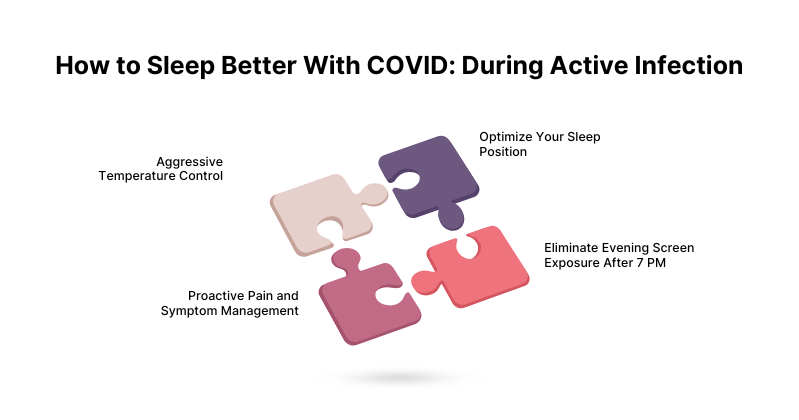
Prone positioning (sleeping on your stomach) or side-sleeping can reduce airway restriction and improve nocturnal oxygen saturation. Elevating the head of the bed by 15–30 degrees also reduces post-nasal drip and inflammatory pressure on airways, both of which trigger nighttime waking.
COVID fevers and night sweats create a thermal environment that actively opposes sleep onset. Sleep initiation is facilitated by a drop in core body temperature, which fever directly prevents. Keep your room between 65–68°F, use moisture-wicking bedding, and keep a cool, damp cloth accessible.
During COVID, when the nervous system is already dysregulated, blue light exposure is significantly more disruptive than usual. It compounds cortisol production and suppresses whatever melatonin production your body can still manage. Replace screen time with audiobooks, calming music, or guided meditations.
Body aches, headaches, and throat discomfort worsen at night and become primary sleep disruptors. Rather than waiting until pain wakes you, take physician-approved pain relief 30–45 minutes before your target sleep time to prevent the awakening before it occurs.
When sleep problems extend beyond the acute infection, particularly in long COVID, a structured treatment approach is necessary. The following represent the highest-evidence options currently available.
Cognitive Behavioral Therapy for Insomnia (CBT-I)
Sleep Restriction Therapy
Targeted Melatonin Use
Psychiatric Medication Options
Important Clinical Note
.Breaking the Anxiety-Insomnia Loop
Not every disrupted night after COVID warrants clinical intervention. But the following indicators clearly signal that self-management is insufficient and that professional psychiatric or psychological support is needed:
Warning Indicator | Clinical Significance |
Sleep problems persist for more than 4 weeks post-recovery | Transition from acute to chronic insomnia disorder |
Daytime functioning is significantly impaired | Insomnia affecting work, safety, or relationships |
Anxiety or depression symptoms are escalating | Psychiatric comorbidity requiring integrated treatment |
Using alcohol or self-medication for sleep | Risk of developing secondary substance dependence |
Bedtime has become associated with dread | Conditioned hyperarousal requiring behavioral intervention |
Cognitive symptoms (brain fog, memory) are worsening | Neurological impact requiring comprehensive evaluation |
At Faith Behavioral Health in Frisco, TX, our psychiatrists and mental health clinicians specialize in exactly these intersections where sleep problems are woven together with neurological, psychological, and behavioral factors. We provide comprehensive evaluations and individualized treatment plans.
COVID changed a lot of things for a lot of people, but one of its quietest, most persistent aftereffects is what it does to sleep. If you’ve been struggling to fall asleep, staying asleep, or waking up feeling like you never slept at all since your infection, you are not weak, you are not overthinking it, and you are not simply “stressed.”
The encouraging reality is that COVID-related insomnia whether from the acute infection or from long COVID, is not a permanent sentence. With the right understanding of why it happens, the right behavioral strategies, and when needed, the right clinical support, sleep can and does improve.
Some people experience mild sleep disruption for 1–3 days after vaccination due to temporary immune activation. Unlike COVID-related insomnia, these symptoms are short-lived and do not become chronic.
Yes, prolonged insomnia can condition the brain to associate the bedroom with wakefulness. Early treatment with CBT-I helps prevent temporary sleep disruption from becoming chronic insomnia.
Yes, children and teens often develop delayed sleep schedules rather than classic insomnia. Anxiety, depression, school stress, and increased screen time can further worsen sleep issues in this age group.
Yes, a negative test only means the virus is no longer detectable in the respiratory tract. Long COVID symptoms, including sleep disturbances, may continue due to ongoing neurological and immune system effects.
Grief-related insomnia is usually linked to sadness, stress, and intrusive thoughts about loss. COVID-related insomnia is more physical, involving difficulty sleeping even when emotional distress is minimal.
Yes, sleeping in a cool, dark, and clean-air environment may improve sleep quality in post-COVID patients. Measures like prone sleeping, HEPA filters, and blackout curtains can support better nighttime recovery.
Why Do I Feel Anxious for No Reason? Have you ever been sitting at home, watching TV, working at your desk, or even relaxing with

How to Cure Boredom and Turn Restlessness into Productivity Boredom is often dismissed as a fleeting inconvenience, but it can feel overwhelming when it lingers.

Can You Die From a Panic Attack? Panic attacks are sudden, intense episodes of fear and anxiety that can be overwhelming and physically debilitating. These

As a skilled psychiatrist, I specialize in preventing, diagnosing, and treating mental health issues, emotional disorders, and psychotic conditions. Drawing on diagnostic laboratory tests, prescribed medications, and psychotherapeutic interventions, I strive to provide comprehensive and compassionate care for my patients in Frisco and McKinney, Texas, while assessing their biological, psychological, and social components of illnesses. I am committed to helping them achieve healthier and more fulfilling lives through my work.