
Abandonment Anxiety: The Silent Fear That Controls Relationships
Abandonment Anxiety: The Silent Fear That Controls Relationships Have you ever felt a wave of panic when someone doesn’t reply to your message right away?
We are open on Saturdays now! | We are doing Virtual Appointments. | Most HMO Plans Accepted.

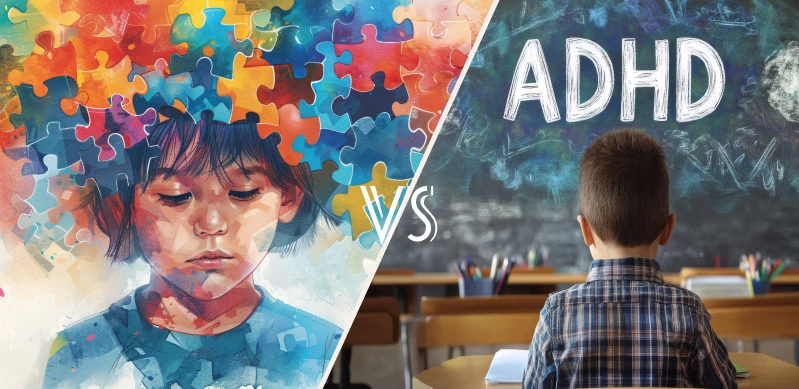
Your child forgets instructions the moment they’re given. Your partner seems lost in social situations. You’ve been Googling at midnight, wondering: Is this ADHD? Is this autism? Are they even different? You’re not alone — and you’re asking exactly the right question.
The short answer: autism and ADHD are not the same — but they share so much common ground that even experienced clinicians sometimes struggle to tell them apart. And in 2026, the science is revealing something even more fascinating: a significant number of people have both.
This guide breaks down everything you need to know — from the core differences in brain biology, to shared symptoms, to what living with both conditions at once looks like in adults and children.
KEY STATISTICS AT A GLANCE |
5% of children globally have ADHD | 1 in 36 U.S. children diagnosed with autism | 50–80% of autistic individuals also have ADHD traits | 2013 Year dual ASD+ADHD diagnosis was recognized |
Both Attention-Deficit/Hyperactivity Disorder (ADHD) and Autism Spectrum Disorder (ASD) are neurodevelopmental conditions — meaning they originate in how the brain develops from early childhood. But their signatures are distinct.
ADHD is defined by persistent patterns of inattention, hyperactivity, and impulsivity that interfere with daily functioning. It affects roughly 5% of children globally, and many carry it into adulthood.
Autism Spectrum Disorder (ASD) is characterized by challenges in social communication and interaction, alongside restricted, repetitive behaviors and interests. The “spectrum” part is critical — autism presents very differently from person to person.
🔑 KEY TAKEAWAY ADHD is primarily a condition of attention and impulse regulation. Autism is primarily a condition of social communication and pattern-based thinking. While both begin in childhood brain development, they have distinct origins — and distinct treatments. |
A landmark 2025 study in Biological Psychiatry used brain scans from 4,255 individuals — the largest of its kind — to map structural differences between ADHD, autism, and co-occurring AuDHD brains.
🟠 ADHD BRAIN • More global cortical thickness increases • Lower cortical volume & surface area • Dopamine regulation pathways disrupted • Executive function networks less coordinated • Age-related brain changes more prominent | 🟢 AUTISM BRAIN • Cortical thickness localized to superior temporal cortex • Social processing regions differ structurally • Sex modulates brain anatomy (females differ) • Sensory processing pathways amplified • Greater pattern-recognition network engagement |
.
Understanding the difference between ADHD and autism in adults and children comes down to several key dimensions. Here’s a clear clinical comparison:
Feature | 🟠 ADHD | 🟢 Autism (ASD) |
Core challenge | Attention, hyperactivity, impulse control | Social communication; restricted & repetitive behaviors |
Diagnosis age | Later childhood (6–12 yrs) | Often before age 3; sometimes in adolescence if mild |
Social difficulties | Present due to impulsivity/inattention — not core | Central feature — reading cues, emotional reciprocity |
Repetitive behavior | Not a defining feature | Hallmark — rituals, routines, intense specific interests |
Sensory sensitivity | Can occur; not a primary criterion | Very common — over/under-reaction to sensory input |
Eye contact | Usually typical; may drift due to inattention | Often reduced or differently managed |
Gender prevalence | More commonly diagnosed in males; gap narrowing | More common in males; sex differences affect brain anatomy |
First-line treatment | Stimulant medication + behavioral therapy | Behavioral therapies (ABA, CBT); meds for co-occurring Sx |
Genetic overlap | High heritability; shared genes with ASD | High heritability; shared genetic risk with ADHD |
| “If a youth with autism presents with irritability and challenging behaviors, a provider might prescribe an antipsychotic — but if the underlying issue is actually ADHD, an antipsychotic is not the first-line treatment. Accurate diagnosis is life-changing.” — Elicia Fernandez, Child & Adolescent Psychiatrist, UC Davis MIND Institute (2025) |
Here’s what makes the autism and ADHD together symptoms conversation so complex: both conditions share a striking number of behavioral features. A 2024 systematic review in Frontiers in Psychiatry confirmed that both ADHD and ASD share significant deficits in executive function — the mental skills that help us plan, organize, and control behavior.
ADHD Only | Shared by Both | Autism Only |
Hyperactivity / ‘always moving’ | Executive function deficits | Difficulty reading social cues |
Impulsive decisions without thinking | Difficulty sustaining attention | Intense, narrow interests |
Forgetfulness in daily tasks | Emotional dysregulation | Repetitive behaviors (stimming) |
Frequently losing objects | Social difficulties | Sensory processing differences |
Interrupting conversations | Frustration with change | Need for sameness / rigid routines |
Time blindness | Sleep disruptions | Delayed language development (some) |
| Anxiety (co-occurring) |
|
FAITH BEHAVIORAL HEALTH Not Sure If It’s ADHD, Autism, or Both? Our experienced psychiatrists provide comprehensive evaluations that go beyond checklists — because your brain deserves more than a guess. |
Yes — and it’s more common than most people realize. Before 2013, clinicians were actually instructed not to diagnose ADHD when autism was present. The DSM-5 changed that, officially recognizing that you can have both ADHD and autism.
The neurodivergent community has coined the term “AuDHD” — a shorthand for this dual-diagnosis experience. Having both conditions simultaneously creates a unique neurological profile that is not simply “more” of either condition.
📊 THE AUDHD OVERLAP BY THE NUMBERS 50–80% of autistic individuals also meet criteria for ADHD. A 2025 neuroimaging study confirmed that co-occurring AuDHD produces a brain structure profile that does not match either condition alone — confirming it is neurologically distinct. |
“The overlap in behavioral features, brain structure, and genetics across autism and many psychiatric disorders highlights the transdiagnostic nature of many neurodevelopmental traits — calling into question existing diagnostic boundaries.” — Autism Science Foundation, 2025 Year in Review |
While both conditions emerge in childhood, the experience in adulthood can look very different. Understanding the difference between ADHD and autism in adults often requires looking past coping strategies that can mask underlying struggles.
Adults with ADHD often report consistent difficulty with deadlines, staying organized, and managing time. Relationships may suffer due to forgetting commitments or seeming “distracted.” Many describe feeling like they’re always one step behind — despite intelligence and genuine effort.
High-functioning autistic adults often describe the immense cognitive effort required to navigate social norms — sometimes called “masking.” Many adults receive an autism diagnosis only in their 30s, 40s, or later. The social confusion is real, but the reason is different from ADHD.
Adults living with both high-functioning autism and ADHD often describe a paradoxical experience: hyperfocusing for hours on a passion project, yet being unable to complete a routine email. This combination is not “more” of either condition — it is a unique neurological experience.
⚠️ THE MISDIAGNOSIS RISK UC Davis MIND Institute (2025) found that some young children initially suspected of having autism were later found to have the inattentive presentation of ADHD — and vice versa. Misdiagnosis leads to wrong treatment, which can make things significantly worse. |
This is one of the most searched questions online — and it deserves a direct, honest answer: neither condition is inherently “worse” than the other. This framing can actually be harmful, because it implies a hierarchy where none exists.
What matters — profoundly — is severity, support, and co-occurring conditions. Research consistently shows that having both conditions together — AuDHD — typically presents more complex challenges than either condition alone, particularly in the areas of executive function, flexibility, and emotional regulation.
⚖️ THE RIGHT QUESTION TO ASK Instead of asking “which is worse,” ask: Which specific challenges is this person facing, and what targeted support will help them most? That’s the clinical and compassionate approach — and it’s exactly how our team at Faith Behavioral Health approaches every evaluation. |
FAITH BEHAVIORAL HEALTH Getting the Right Diagnosis Changes Everything At Faith Behavioral Health, we use gold-standard assessments to find the real picture — and build a care plan that actually works for your brain. |
The science of autism and ADHD has moved faster in the past two years than in the previous decade. Here are the most important findings reshaping how we understand these conditions:
🧬 Shared Genetic Architecture
Multiple studies now confirm significant genetic overlap between ADHD and autism. They share neurodevelopmental risk pathways — which is why they so often co-occur in the same individual.
🧠 Brain Scans Show Distinct Signatures
A 2025 study of 4,255 brain scans confirmed that autism and ADHD produce distinct — but overlapping — patterns of cortical thickness and surface area. Co-occurring AuDHD has its own unique pattern.
👩 Sex Differences Matter
Sex modulates the neuroanatomy of autism but not ADHD. Females with autism may mask better and are diagnosed significantly later than males — a critical finding for clinicians.
🔄 Early Autism Predicts Later ADHD
UC Davis MIND Institute (2025) found that an early childhood autism diagnosis is a strong predictor of a later ADHD diagnosis — underscoring the need for ongoing developmental monitoring.
💊 Treatment Must Match the True Diagnosis
Stimulants that work well for ADHD can be less effective — or cause different side effects — when autism is also present. This makes accurate dual diagnosis clinically critical.
Q: Is autism and ADHD the same condition?
No. While both are neurodevelopmental conditions that share some overlapping symptoms, they have distinct causes, brain profiles, and core challenges. ADHD centers on attention and impulse control; autism centers on social communication and repetitive patterns. They are separate diagnoses — though they frequently co-occur.
Q: Can you have both ADHD and autism at the same time?
Yes — and it’s quite common. Since the DSM-5 (2013), clinicians can diagnose both simultaneously. Research indicates 50–80% of autistic individuals may also meet criteria for ADHD. This dual presentation is sometimes called “AuDHD” in the neurodivergent community.
Q: What is the difference between ADHD and autism in adults?
Adults with ADHD typically struggle most with time management, organization, and impulsive decision-making. Adults with autism more often report difficulty navigating social expectations, sensory overwhelm, and a strong need for routines. Both may have developed coping strategies that mask their struggles — making professional evaluation essential.
Q: Can high-functioning autism look like ADHD?
Absolutely. High-functioning autism in children and adults can present with apparent inattention, social awkwardness, and emotional dysregulation that closely resembles ADHD. A proper assessment — including a detailed developmental history and standardized tools — is essential to distinguish between them or identify both.
Q: How are autism and ADHD treated differently?
ADHD is commonly treated with stimulant medications and behavioral therapy. Autism treatment focuses on behavioral therapies such as ABA or CBT, social skills training, and sometimes medications for specific symptoms like anxiety or irritability. When both are present, treatment must be carefully tailored — stimulants can affect autistic individuals differently and require close monitoring.
FAITH BEHAVIORAL HEALTH Your Mind Deserves Expert Care — Not Just Guesses Whether you’re seeking answers for yourself or your child, our compassionate team at Faith Behavioral Health is here to guide you from confusion to clarity — with science-backed assessment and individualized care. |
Abandonment Anxiety: The Silent Fear That Controls Relationships Have you ever felt a wave of panic when someone doesn’t reply to your message right away?

Is Narcissism Genetic? A Closer Look at Narcissistic Personality Disorder Imagine living with someone who constantly craves admiration, lacks empathy, and has an inflated sense

How Does TMS Therapy Help Manage Anxiety & Depression? When it comes to managing anxiety and depression, Transcranial Magnetic Stimulation (TMS) therapy is a non-invasive

As a skilled psychiatrist, I specialize in preventing, diagnosing, and treating mental health issues, emotional disorders, and psychotic conditions. Drawing on diagnostic laboratory tests, prescribed medications, and psychotherapeutic interventions, I strive to provide comprehensive and compassionate care for my patients in Frisco and McKinney, Texas, while assessing their biological, psychological, and social components of illnesses. I am committed to helping them achieve healthier and more fulfilling lives through my work.